
Welcome

LR's EMAIL LIST
Press Highlights
Music for Broadway, Off-Broadway and...
1. "Act One" (Broadway Lincoln Center Beaumont Theater)
2. "Picnic" (Broadway)
3. "Doctor Faustus" (Oak Park Festival Theater, Chicago)
4. "The Rainmaker" (Broadway)
5. "Orchards" (Off-Broadway, National Tour)
6. "Thesmophoriasouzae" (Court Theater, Chicago)
* * *
Deadline | Hollywood
The Best Of Broadway (And Off-)
by Jeremy Gerard, 12-18-17, 12:05 pm
"Best Stocking Stuffers of 2017"
("A made-up category, because there are theater-related CDs and books deserving of mention in any year-end list.)
"CDs: The Broadway cast album of The Band’s Visit has just come out, and it’s gorgeous, a showcase not only for star Katrina Lenk (“Omar Sharif” will be this year’s “You Will Be Found”) but for composer/lyricist David Yazbek… Another recent and beautifully executed album is Anaïs Mitchell’s Hadestown, which started out at New York Theatre Workshop and we hope will come to Broadway.
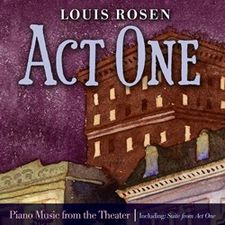
Di-Tone Records
"Louis Rosen is releasing several CDs, including his latest wry song collection, Dust To Dust Blues. Yet the album that has me enchanted is Act One: Piano Music from the Theater, which includes his incidental music from James Lapine’s adaptation of the Moss Hart autobiography and other works. Exquisitely played by several different pianists and intimately recorded, these works taken together have the fleeting, transportive power of études by Chopin or Debussy; I find myself listening to them again and again…"

By Raul de Gama, February 1, 2018
Louis Rosen: Act One: Piano Music from the Theater
This is a dramatically different (no pun intended) recording from Dust to Dust Blues. It is wholly instrumental, and it puts to the test all of Mr. Rosen’s power to create mighty themes, but to also create and describe events with pinpoint accuracy edge-of-the-seat drama, and most of all to bring all of this to life in poignant music. Mr. Rosen’s skill at making this come together in breathtaking, simple and utterly remarkable piano works is what we find on this recording of fourteen segments. The writing, spotlighted by the voice of a singular instrument, is idiomatically beautiful and powerful throughout these fourteen works.
The music is centered on the “Act One Suite”, a work in six parts that explores several themes. Because the work is not prefaced by an overture, the surprises are as frequent as the sections themselves. The “Suite” itself takes us into a world full of glinting lights, mysterious depths, expectations, frustrations, hopes and doubts, like the shattered shadows of a sinister quasi-Mendelssohnian cadenza, glimpsed by moonlight in a forest. And in the sheer colour and variety, in the depth of its characterisation and the exceptional range and refinement of pianism, Kimberly Grigsby imparts all the power and stature that Mr. Rosen intended for the piece.
The rest of the music is by no means incidental, nor are the performances of pianists Ted Sperling, Joseph Thalken, Peter Lurie, Barbara Keller and Melissa Shifflet to me viewed in a lesser light. The music they play is performed with seductive persuasion; an object lesson in the very essence of style. Each piece is played with buoyant, aristocratic grace and with an almost insolent effortlessness. Each brings a debonair virtuosity and swagger to the performance. All in all, a world of piano styles evoked as few could even hope to try, let alone achieve.
Track list – Act One Suite Part 1: Opening: The City; Part 2: Slow Blues; Part 3: Traveling Music; Part 4: Typing Variations; Part 5: M’s Blues; Part 6: Suite Stride. Into Night and on the Verge – 7: Into Night; 8: On the Verge. Two Waltzes – 9: Waltz for Steve; 10: Waltz In 5/4. Orchards – 11: The Talking Dog; 12: Rifcula’s Ring. (One movement from) Music for Galileo – 13: Cardinal’s Waltz. (One Movement from) The Winter’s Tale Suite – 14: Pageant
Personnel – Kimberly Grigsby: piano (1 – 6); Ted Sperling and Joseph Thalken: pianos (7, 8); Peter Lurie: p [piano (9, 10); Barbara Keller and Melissa Shifflet: pianos (11, 12, 13); Barbara Keller: piano (14)
Released – 2017
Label – Di-Tone Records
Runtime – 42:21

Louis Rosen: Act One-Piano Music from the Theater— Evocative
Posted on October 3, 2017 by Alix Cohen in Playing Around
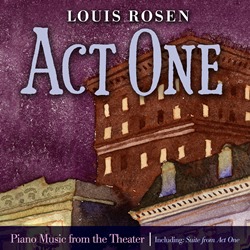
Louis Rosen composer/songwriter/librettist/musician/author/educator started composing for theater right out of music conservatory in 1977. The artist has written more than thirty scores for various Broadway, Off Broadway and regional productions. This recording features piano music – sometimes excerpted from longer suites, created for theater.
Having reviewed Rosen’s music forays into other genres, listened to a great deal of it, and written a profile on the artist (see the story), I admit to being surprised by these pieces. Each and every one is immensely evocative. I found myself rife with impressions, conjuring scenarios. Herein some of them:
Act One Suite is drawn from a score written for the Lincoln Center Production of James Lapine’s Act One, based on the autobiography of playwright/director Moss Hart. The six pieces would make a wonderful dance. I heard: 1. Gershwinesque; cool, sinewy, dark 2. Deeply sighed dusk, thoughtful, melancholy, languid 3. Zoot-suited Harlem street scene; tilted hats, clean spats, dandies and dames sashay 4. Geometric, jigsaw, action/reaction 5. Hip-swinging, dancing drunk, wet streets, blinking lights 6. Broadway Babies.
Waltzes for Eugene O’Neill’s Long Day’s Journey Into Night (Portland Stage Company) and Eric Overmeyer’s On the Verge (The Huntington Theater, Boston) offer two very different takes. The O’Neill piece is delicate, haunting, half way between dream and waking; handmade lace, crystal reflections from a heavy chandelier, sadness. The one for Verge is filled with intention/anticipation, bobbing and ducking, on the move; a lighter parenthesis – I imagined a child imitating an adult, followed by the original figure engulfed in a stream of humanity.
Earlier waltzes are from Rosen’s first assignment, Romeo and Juliet (The Oak Park, Illinois Festival Theater) and then a composition for the First Young Playwrights Festival in New York City. To me, the first is a broken doll dancing with a sympathetic soldier who fell in love before he saw she was crippled – exhilarating, but tough. The second is lighter-romantic, dappled, yet questioning.
There are more. I recommend listening with eyes closed. My single caveat is that some of these are not long enough. One just gets enmeshed and the image fades. A highly pleasurable CD showcasing diverse influences, talent, and imagination.
* * *


JAZZ CD REVIEWS FOR APRIL 2018 by Scott Yanow
Louis Rosen
Act One
(Di-Tone Records)
Louis Rosen is certainly a multi-talented individual. A singer-guitarist and an author, Rosen is perhaps most significant as a composer and lyricist of songs for the theater and stage. Among those who he learned directly from were Stephen Sondheim and Leonard Bernstein. Among his works is his Dream Suite, a cycle of 14 songs that utilize the poems of Langston Hughes.
Act One is Rosen’s adaptation of some of the songs that he wrote for the theatre, recast as instrumental works performed by one or two pianists. “The Act One Suite,” which includes six pieces from his 2014 Broadway production of Act One, is the strongest from the jazz standpoint. The work, which is set during the years 1925-30, purposely has pianist Kimberly Grigsby playing in a variety of 1920s piano styles. One can certainly hear bits of George Gershwin’s style along with stride piano and blues. Other pieces feature pianists Ted Sperling, Joseph Thalken, Peter Lurie, Barbara Keller, and Melissa Shiflett with the music taken from six productions including Long Day’s Journey Into Night, Romeo and Juliet, and Galileo. The music explores many moods and is often melodic while bridging the gap between classical music, the blues and jazz.
This enjoyable set is available from www.louisrosen.com .
* * *

1. PICNIC (1994)
Broadway, directed by Scott Ellis, choreographed by Susan Stroman
NEW YORK DAILY NEWS - Review

NEW YORK MAGAZINE - Review

* * *
2. DOCTOR FAUSTUS (1981)
Oak Park Festival Theater, Chicago, directed by Patrick O'Gara
CHICAGO SUN-TIMES - Review

* * *

3. THE RAINMAKER (1998/2000)
Broadway (via Williamstown Theater Festival), directed by Scott Ellis
Broadway Snap-Shot - Review (partial)

CURTAIN UP - Review (partial)


* * *

4. ORCHARDS (1985-86)
The Acting Company, Off-Broadway, Goodman Theater, Chicago & National Tour, directed by Robert Falls
CHICAGO SUN-TIMES - Review

* * *

5. THESMOPHORIASOUZAE or Ladies Day (1977)
Court Theater, Chicago, directed and translated by D. Nicholas Rudall
CHICAGO DAILY NEWS - Review

HYDE PARK HERALD - Review

THEATERS: 7 WINNERS BY YOUNG PLAYWRIGHTS
By Mel Gussow
In collaboration with the Dramatists Guild Fund Inc., the Circle Repertory Company is presenting a Young Playwrights Festival. The admirable purpose, of course, is to encourage young people to write plays, but at least from this year's selections, chosen from 732 submissions, there would seem to be a shortage of quality work.
Three of the plays, each of them written by a 17- or 18-year-old, deal with stereotypical adolescent anxieties, mostly directed against parents who are either absent or absentminded. Although each author demonstrates at least a modicum of writing ability, all three efforts are blunted by self-pity and sentimentality. If they were written by adults, they would have probably not been produced.
In direct contrast are the two plays by the festival's youngest winners, ''So What Are We Gonna Do Now?,'' by Juliet Garson, 13, and ''It's Time for a Change'' by Adam Berger, 8. It would be hasty to assume that the two youngsters are playwrights, but their plays are entertaining. If they were written by adult dramatists, one might say that ''Miss Garson and Mr. Berger have regained the spontaneity and imagination of their earlier work.'' Actually, each piece might have a future in children's theater, although Miss Garson's subject and language are rather more explicit than one finds in such circumstances.
Her heroines are two preteen best friends who act out their fantasy lives. Deciding that it is healthier to go into ''the streets of slime'' (New York) than to ''live in a house of distrust'' (that's a house populated by parents), they dress garishly and pretend to be prostitutes while knowing nothing about the art of proposition. There is an innocence underneath the supposed sophistication.
''It's Time for a Change'' is even more fanciful. The play's protagonist is terrible in gym and a figure of fun to his classmates, but he knows how to ski. One morning he borrows his father's snow maker - a deus ex snow machina - and fills the school gym with snowflakes. Then he leads his class, including the bullies, in cross-country skiing, miming a race to music with a ''Chariots of Fire'' beat.
These are the sort of sketches that children through the ages have written in privacy and presented in attics for the amusement of their peers and parents. In a Young Playwrights Festival, both benefit from bright professional productions, including adaptable stage designs by John Lee Beatty.
In ''So What Are We Gonna Do Now?'' Arthur Laurents has directed two children, Lucy Deakins and Kate Anthony, into giving appealing performances. Elinor Renfield has staged ''It's Time for a Change'' as a fairy tale, with an adult actor, Timothy Busfield, playing the skier with a childlike sense of wonder. He is also amusing as the Walter Mittyish hero of John McNamara's ''Present Tense,'' an attenuated comedy sketch about a young man with romantic problems. In a variety of roles in other plays, there are apt performances by David Labiosa and Karen Sederholm.
The two programs of plays, running in repertory through May 16, are of interest more for their psychological implications than for their theatrical value. One might conclude that adolescents share a pessimistic view of their lives - a sad commentary on growing up today. The concerns are serious and perhaps in time the playwrights will be able to express them in a more artful fashion.
Until July 1, the Dramatists Guild will be solicing manuscripts for next year's festival. The Program YOUNG PLAYWRIGHTS FESTIVAL. Sets by John Lee Beatty; costumes by Ann Roth; lighting by Dennis Parichy; sound by Chuck London Media, Stewart Warner; music by Louis Rosen (''It's Time for a Change'') and David Valentin (''The Bronx Zoo''); production stage manager, Jody Boese; stage manager, Kate Stewart; Gerald Chapman, festival director; Peggy Hansen, festival administrator; Richard Frankel, acting managing director of the Circle Repertory Company. Presented by the Dramatists Guild Fund Inc. in association with Circle Repertory Company. At 99 Seventh Avenue South. BLUFFING, by Peter Murphy; directed by Carole Rothman. PRESENT TENSE, by John McNamara; directed by Marshall W. Mason. THE RENNINGS CHILDREN, by Kenneth Loner- gan; directed by Mr. Mason. IT'S TIME FOR A CHANGE, by Adam Berger; directed by Miss Renfield. THE BRONX ZOO, by Lynnette Serrano; directed by Mr. Chapman. HALF FARE, by Shoshana Marchand; directed by Miss Renfield. SO WHAT ARE WE GONNA DO NOW? by Juliet Garson; directed by Arthur Laurents. WITH: Kate Anthony, Jonathan Bolt, Timothy Busfield, Lucy Deakins, Wanda De Jesus, Trish Hawkins, David Labiosa, Bruce McCarty, Alba Oms, Burke Pearson, James Pickens Jr., Zaina Rivera, Karen Sederholm and Ted Sod.
Editors’ Picks
THEATER: ONE-ACT COMEDIES
By Mel Gussow
Jan. 24, 1985
''THE ART OF SELF-DEFENSE'' by Trish Johnson is the longest and most skillfully developed of the three plays in the first evening of Manhattan Punch Line's festival of one-act comedies. In it, five women study tai chi in order to find the road to inner tranquillity.
In common with the other two works, ''The Art of Self-Defense'' has its formulaic aspects, in this case the night class as a microcosm of urban life. It would benefit from further definition as to the individual reasons that propel the women into their shared endeavor. But the comedy has timeliness and pungency, and it is given an empathetic performance by a quintet of talented actresses.
Clearly the author has served her self-help time and has mastered the art of jargon. Led by an unseen instructor, the women try to lose tension as if it were excess poundage while learning such Eastern disciplines as Repulse the Monkey. Over a period of months, the women become friendly and then move on to their various roles as life's winners and losers.
The characters are variegated and the actresses are precisely cast - Denise Bessette, Gina Barnett, Helen Harrelson, and, especially, Caryn West who has her own tranquil beauty, and Kathrin King Segal who, as the mother of quadruplets, has a goodly share of the play's sharpest lines.
Mark D. Kaufmann's ''Backbone of America'' is a two-handed comedy about a lonely 10-year-old boy and his bored, law-student sitter. With a degree of cleverness, but with some sacrifice of credibility, the playwright maneuvers the two into an amusing relationship before the play spins into sentimentality.
The law student is exceedingly slow in his reactions, while the child is precocious. In fact, the 10-year-old is so adult that one wonders if he really needs a sitter. He gets the upper hand by reading the sitter's misfortune on tarot cards - there is all doom in the future. Stephen Hamilton and Cameron Charles Johann work well together as the unevenly matched man and boy.
Opening the evening is Nina Shengold's ''Women and Shoes,'' a pseudo- Mamet mini-conversation between two male chauvinists in a bar. The sketch deals briefly but interminably with the title subject. As one of the women in that tai chi class says to a long-winded friend, ''Is this story inherently interesting?''
Using adaptable settings by Jane Clark and Christopher Stapleton, all three plays are neatly directed - by Mitch McGuire, Porter Van Zandt and Steven D. Albrezzi, who staged the episodic ''Art of Self-
Tai Chi and Some
FESTIVAL OF ONE-ACT COMEDIES, Evening A. Settings by Jane Clark and Christopher Stapleton; costumes by David Loveless; lighting by Scott Pinkney; sound by Bruce Ellman; original music for ''The Art of Self-Defense,'' by Louis Rosen; production stage managers, David Lansky and Lori Rosecrans; production manager, Pamela Singer; associate producer, Kathi Levitan; managing director, Patricia Baldwin; artistic director, Steve Kaplan. Presented by Manhattan Punch Line Theater, Mr. Kaplan and Mitch McGuire, producing directors. At the Judith Anderson Theater, 422 West 42d Street.