
PRESS for “AMERICAN SUNSET”
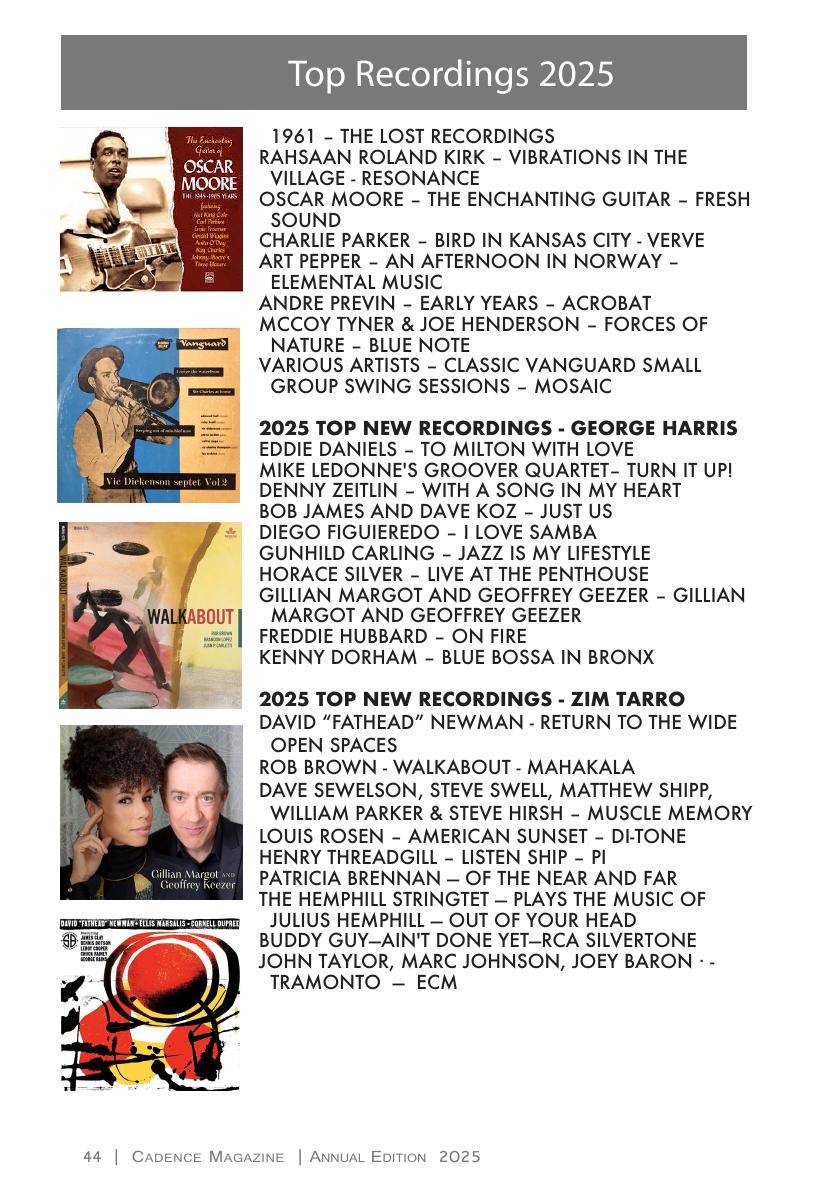
TOP TEN ALBUM OF 2025 in CADENCE JAZZ MAGAZINE'S CRITICS POLL
- The award-winning novelist and Substack columnist, Lorraine Devon Wilke, wrote:
"Stunning work, and truly a concept album... ‘American Sunset’ is a perfect elegy to our battered country, a jazz protest song cycle… It is brilliant.”

Jazz Weekly - Creative Music and other forms of Avant Garde
A MUSICAL MESSAGE…Louis Rosen: American Sunset
by George W. Harris • October 13, 2025
If singer/guitarist/ composer lived in another era, he’d probably be linked to artists like Gershwin or Waller if he walked the streets during the Depression, or maybe be a Randy Newman/Tom Waits kind of guy if he was a seventies kind of guy. He’s built up an impressive catalogue of albums that always carry some sort of theme, kind of like what Sinatra did back with Capitol Records, but with his own style and voice.
This time around, Rosen (who’s taken up issues ranging from race to COVID) takes on the current American political scene with Charity Wicks/p, Pete Donovan/b and Andy Blanco/dr-vib, creating a red, white and blue tapestry that mixes challenges, satire and ultimately hope.
Rosen shows he also know how to swing, as there are a couple of instrumentals, with the vibes grooving on “Tango For Charlie”, Wicks suave on “Elegy” and Rosen adding spoken text about January 6 on the thoughtful “Executive Orders”. There’s a nice tongue in cheek sardonic wit on the fun and frisky “Gulf of Mexico” with a mix of Broadway and bohemia for the title tune. “Rosen and Wicks get into a troubadour mood for “American Clown Car March” and bear down on the funk factor for the economic editorial of “Last Things First.” And yet, while Rosen is able to point to the king with no clothes, he still remains optimistic for our country, as the honky tonking “The Wheel Goes “Round” as well as the closing “And Still I Sing” still salute what is the world’s greatest hope. As Churchill once said, ”Defeat is never fatal; victory is never final; it’s courage that counts. Rosen gives the heat, but stays in the kitchen.
- The award-winning biographer and cultural critic, Jeremy Gerard, wrote:
“I'm knocked out…. American Sunset is a stunner. As both a gifted composer's wholly original tonal map of the times and as a storyteller of acute intelligence and poignance, this is indeed Rosen’s finest work, and the technical production is every bit up to that standard. I will admit to hearing these notes, like the ineffable lingering tastes of a fine wine savored: I hear Randy Newman's very early Live album, I hear Harold Rome's expansive gifts, from Pins and Needles to The Zulu and the Zayda, and, perhaps inevitably, I hear Brecht and Weill pleading for conscience in an unconscionable time.”

The Art & Craft of Protest: AMERICAN SUNSET by Composer Louis Rosen
By Lorraine Devon Wilke
October 31, 2025
"A writer should speak with candor and truth no matter what they’re writing about, whether political or personal. That’s the writer’s obligation."
I read a rather plaintive post on social media recently asking, “Where are the protest songs of this era?” and thought it was, frankly, a salient question. Having come up at a time when protest songs were simply part of the everyday listening landscape, there does seem to be a dearth of such things in this MAGA moment … though, it appears there is a public playlist on Spotify called, “Donald Trump Protest Songs.” It’s a fairly lengthy collection, with some names I recognized, but I’ll leave it to you to listen and see if it meets the demand.
Cuz I got Louie Rosen … or “Louis Rosen,” as he’s known to his many fans.
I’ve known Louie since we were kids in college back at the University of Illinois in Champaign/Urbana. I was a theater major; he was in music. He ultimately landed in New York; me, LA. We’ve stayed connected over the decades, and have been supporters of each other’s artistic endeavors from the get-go. He reads my books, listens to my music, I collect his albums and anytime Lou is playing at, say, Joe’s Pub in NYC or Davenport’s in Chicago, I’m there.
Louie’s list of compositions and albums is breathtaking in scope and creativity, his official bio stating, “Louis Rosen is a composer, lyricist, performer, author, guitarist, educator and Guggenheim Foundation Fellow in Music Composition, whose musical style fuses and juxtaposes classical, folk, jazz and popular styles.”
Given this impressive resume, and my lifelong appreciation of his myriad talents, I’m always delighted when Louie gives me an early listen to his latest work, as I was recently gifted with his just-released album, American Sunset.
To call it a “departure” is not exactly accurate. Though his milieu does tend to fall more in the songbook, theater, jazz arenas (he worked for years with vocalist, Capathia Jenkins; those albums are some of my favorites), his expansiveness as a composer is notable. Still, American Sunset veers hard and unvarnished into “protest” territory, and I gotta say; I am so here for it!
With twelve tracks (and a bonus thirteenth track), and Louie’s unique, evocative vocals interpreting the lyrics, it’s a profound musical statement. I’ll let the album description make the point:
“AMERICAN SUNSET is a twelve-song cycle—or if you’d prefer, concept album—that was mainly written between Election Day, November 5, 2024, and Inauguration Day, January 20, 2025. The album is both a personal and a political response to this unsettled and disturbing American epoch. It’s filled with the immediate intensity of the present, reflected in songs that are by turns dramatic, ironic, comic, and sometimes all of those at once. And AMERICAN SUNSET is a true cycle: while each track stands on its own, the personal narrative and political thematic connection of each song to the whole cycle is immediately clear when the work is listened to from start to finish.”
After doing just that, I had some questions for my friend, and invited him to (virtually) sit down with me and have a conversation about this epic work. He generously obliged.
LDW: Lou, you’ve delved into political issues before in your memoir/oral narrative, The South Side, which was about “white flight” on the south side of Chicago in the 1960’s and 1970’s, but have you ever written a musical album, a collection of songs, a song cycle, or, as the rocker in me likes to call it, a concept album, that’s as overtly political as American Sunset? And if this piece is unique in that focus, share a bit about what compelled you to do so.
LOUIS: No, never an entire album. The times never seemed to warrant it before, though there’s been something pointedly political—or some social commentary—on nearly every album, increasingly since the Bush/Cheney era through Trump, Part 1. But this moment is obviously different. The period between Election Day and Inauguration Day seemed to offer at least one new outrage per day, rhetorical or via the nominations of the many incompetent, unfit characters who were joining the administration. A response seemed more than warranted, it seemed necessary, if only to maintain my own sanity and equilibrium. And if writing helped me process this moment in time, I thought similarly-minded people might get something from listening.
And it was often fun to write. The songs flowed, music and lyrics; the more critical lyrics sometimes provided a pressure-valve-like release, occasionally made me laugh—and again, I thought if I responded that way, so might the listener. It’s enjoyable to write lines like “Look who we admire/scoundrels, megalomaniacs and billionaires”—I think it’s an accurate observation of the direction the culture has gone. I imagined the lyric and music to the darkly comic, “American Clown Car March,” for instance, as a new, contemporary national march. Again, enjoyable to write it, to express the frustration with our current situation in a way that Sousa couldn’t have.
LDW: At this highly polarized time in our country, when so many on the right think artists should “stay in their lane” (i.e., “shut the fuck up”), why do you think it’s essential that artists speak up, speak out; take a stand on the injustices we see unfolding before us daily?
LOUIS: The political right only thinks that artists should “stay in their lane” when they don’t agree with those particular artists. I haven’t heard anyone on the right mention that Kid Rock or Jon Voight should stay in their lanes. More to the point, artists don’t have a particular lane to stay in, so that’s a false argument. An artist’s lane is whatever path she or he chooses to travel down. (Had to highlight that. LDW).
Regarding the second part of your question: I actually don’t think it’s “essential that artists speak up ... take a stand on the injustices...” etc. Artists should do what is true to their nature. Though I attend some protests, or volunteer for a candidate now and then, I always feel I fall seriously short on the activist end of the citizenship scale. But writing about the current chaos was something I could do; and was, in fact, compelled to do. As I suggested above, it was the best way for me to process the madness that was already unfolding in the days between the election and the inauguration; a way to discover, articulate, and share what I was thinking and feeling; to release a bit of the anger and frustration brought by the daily news cycle, and to talk to others who might find some solace or satisfaction in these ideas articulated in a nuanced fashion in song. We know that political and social commentary is an old tradition in music. Some of my favorite songs by some favorite songwriters fall into that category—sometimes those songs are subtle and complex, sometimes agitprop. I like both. I think both can be satisfying. I’m just carrying that tradition forward in my own manner.
LDW: One element of this concept album that I loved is its narrative arc: you not only vent (”American Sunset”), rage (”Last Things First”), and righteously ridicule (”American Clown Car March”), but you find moments for tenderness (”Candice and Me”) and almost wistful hope (”And Still I Sing”). As an artist myself, I often feel compelled to find that balance in what I write, to offer a glimmer of hope despite the outrages we’re all impacted by, and I wondered: was that a compelling impulse for you, too, as you wrote these songs and assembled this album?
LOUIS: Offering hope ... I didn’t set out with that as a plan, but I’m not without hope, so it wouldn’t be honest to write a piece that is completely without it—though it seems to me that hope is parceled out in limited servings from different angles over the course of the piece.
For instance, “The Wheel Goes ‘Round” embraces the notion of karma, a hopeful notion; as you mentioned, “Candice and Me” (which is inspired by Voltaire’s Candide) finds a subtle hope in the embrace of what is real and true in the midst of treacherous times; “Life On Earth” is hopeful in that it’s a gentle meditation on the contradictions of living. Even the rage in “Last Things First” leads to something akin to a call-to-action.
You found the most hope in “And Still I Sing.” The song wasn’t planned, but in looking at the writing process, it seems inevitable. Songs often come in pairs. “And Still I Sing” was written in one sitting, the same day that “Run It Back” was completed. The rage and desperation of “Run It Back” seemed to require an answer, something of an antidote. The intention with “And Still I Sing” was to write a hymn, a song for carrying on “when everything feels broken,” which is a fundamentally hopeful notion. The music itself embodies that notion in that it’s actually a major key transformation of the main musical idea of the two darkest pieces in the cycle, “Executive Orders,” and “Elegy.” I had to understand who the “you” was that I would still sing for. Realizing that it was both the people I love, along with anyone who chose to listen, I knew that I had the conclusion of a larger cycle—which means I knew that I was ending the work on a hopeful note. That’s a long way of saying the conclusion was more discovered than planned.
LDW: I know when I write something overtly political, even controversial—whether an article, a song, a novel—I can expect pushback, anger; trolling. But conversely, and what most pleases me, is how so often people will write or comment with something like, “Thank you for putting into words what I think and feel,” one of the reasons I believe artists must speak with candor and truth. As an expansion on the first question, do you feel a similar obligation, specifically with this album, one that makes no bones about where you stand on these issues, pushback be damned, and gives voice to many who feel the same?
LOUIS: I think that a writer should speak with candor and truth no matter what they’re writing about, whether political or personal. That’s the writer’s obligation. One hopes that the response to the work will be what you suggested, “Thank you for putting into words (and/or music) what I think and feel.” And as we know, the separation between political and personal often gets blurry. But in this piece, there would really be no point in pulling punches. The work would have just ended up as weak tea. One can disagree with the point of view—the critique of the current American political and social culture—but you can’t claim the work doesn’t have one. And the most personal songs ground the work, allowing the cycle to be more than only a political piece.
LDW: And, lastly, given the dedicated fan base you’ve accrued over your career, one that’s been regaled with incredible music that isn’t, perhaps, as political and unvarnished as American Sunset, do you expect any pushback or, conversely, and more positively, to expand your audience to those who will appreciate the rage, the truth, the candor of your political stance?
LOUIS: You are very kind. I never have any idea how the work I offer will be embraced. I just try to write what interests me, and hope that since the subject interests me, there will be people who want to listen. I don’t think interest in this subject matter is unique to me, so I hope that, as intended, it might offer some solace of shared recognition, perhaps a couple of laughs, and maybe a brief infusion of tempered hope to both audiences familiar with my work and those who are new to it. I have no illusion that a song or musical piece ever really changed anyone’s mind. And we’re all so siloed these days. But a song can inspire. As I answer your questions, it’s clear to me that the work is fundamentally about observing the dangerous national chaos that we are in the midst of, and then trying to figure out how to carry on in the difficult face of it.
Lou, thank you for offering such a thoughtful and thorough perspective on your latest work. As we’ve discussed, I, too, find music to be a seminal outlet for our most passionate expressions. Whether waxing on love, aching over heartbreak, or raging about politics and injustice, there’s something uniquely powerful about music—writing it, singing it, playing it, performing it—as a conduit of human emotion. Of commentary and utterance. Of demand and whimsy. You do it all so well. Thank you, my friend.
SUZANNE BOWLING - TIMES SQUARE CHRONICLE PODCAST
“…A voice for the voiceless… a jazz protest. “American Sunset” speaks to the heartbreak and disassociation [we’re experiencing.] It’s kind of like Sondheim’s Assassins. [The music] speaks the entire language of jazz and blues…and Bernstein. It sounds personal…. I felt the heartbreak. [And] “American Clown Car March” is a hilarious song!”

Louis Rosen CD: “American Sunset”- A Thinking Man’s Cri de Coeur
Oct 14, 2025
By Alix Cohen
Musician, singer/songwriter, (author, teacher,) Louis Rosen wrote songs. The artist is low key, articulate, wry, thoughtful, sad, and seething.
“American sunset/You can see it from here/Off in the distance/Yet perfectly clear/Controlling the message/A circle of lies/The limitless profit/That influence buys…” The tune evokes Ray Bradbury’s Something Wicked This Way Comes, hypnotic, sinister.
“The Wheel Goes Round” is one of several spiritual takes on contemporary times. “The debt we accrue comes due…the hour comes all too soon…Not a soul should feel immune…” It’s a hip, Bob Fosse dance, all sharp pelvis and splayed fingers. Fate waits with mawing jaw.
“Life On Earth” has similar feel. We’re the blink of a universal eye, a spec on the history of earth, it seems to say. Melody lulls. Tempo is like breathing; ‘ a mantra. “Our past lies in the ocean/The future’s in the sky…” Evocative melody.
Small, brightly painted circus cars disgorge endless clowns, defying all logic of spatial physics. Trump’s lackeys may not wear rainbow wigs and oversized shoes, squirt flowers and wield rubber chickens, but they’re as limitless, absurd, and obtuse as those confined to the big top. “American Clown Car March”/” The American Oligarch Clown Car March…” with apt percussion, describes the parade.
“Executive Orders” takes the vision further, emerging as a calmly spoken litany, its content familiar, cumulatively horrifying. ‘Dated events. Chinese water torture…Drip, drip, drip. Relentless. Vitriol is reminiscent of Brecht/Weil without excessive volume.
“Candice and Me”… “Wake up each day/And help out garden grow…” leans into a wellspring of love for comfort and confirmation. Feelings land softly like dew on grass. “Still, one and one make two…” Music dips and rises like a helix. Affection echoes.
On its tail “Gulf of Mexico” offers a romantic, hopeful vision of refuge, a rhythmic dance in the sand. Sound is decidedly north of the border. “Run It Back” expresses the inability to run away or even look away. So much for Mexico. Repetition evokes siege.
“And Still I Sing”…A song for you/To guide us through this day…” tracks back to Candice. Whatever happens we have each other. More hymn than ballad, the song is slow and tender. Backup vocals resonate.
Of the instrumentals: “Elegy” pairs funerary drums with delicate memories, rather as one might wish. “Tango for Charlie” is a smoky, sinewy dream. ‘Quite beautiful. Too short. An untitled epilogue feels like a walk in pristine nature, far from people. Like inhaling clouds.
[A]…Significant Jazz Protest Album
Louis Rosen
American Sunset
(Di-Tone Records)
Review by Scott Yanow
It would not be an understatement to say that the election of Donald Trump as president for a second term was a rather depressing event for many Americans. That was certainly true for singer-songwriter Louis Rosen who wrote the pieces on American Sunset (with one exception) after the 2024 election and before the inauguration.
With the sensitive accompaniment of pianist Charity Wicks, bassist Pete Donovan, and drummer Andy Blanco (who occasionally plays vibes), Rosen sings and talks his lyrics while also contributing some acoustic guitar. The pieces, which deal with the end of The American dream, range from disbelief at people voting against their own self-interests to the triumph of greed and the destruction of freedom in this country. While “And Still I Sing” and “The Wheel Goes ‘Round” have a little bit of optimism that things will change again in the right direction and some pieces are about trying to escape the constant bad news, other numbers are filled with the hopeless feeling that one feels at the reality of the situation. Occasionally there is a bit of satire. Most depressing is “Executive Orders” which has Rosen simply reading each of Trump’s executive orders from his first three months in office.
There are a few instrumentals including a second version of “Executive Orders” that features pianist Wicks but American Sunset is primarily for those who may be overlooking what is happening to this country (it is worse than Louis Rosen originally predicted) or want a historical record of the events from the first half of 2025. This significant jazz protest album is available from www.louisrosen.com.